Hardware and modules
Each server consists of hardware and software modules. The table lists the maximum level, requirements and effect of every module. At most 5 upgrades run in the queue at the same time; the number of parallel upgrade slots is the same for all players.
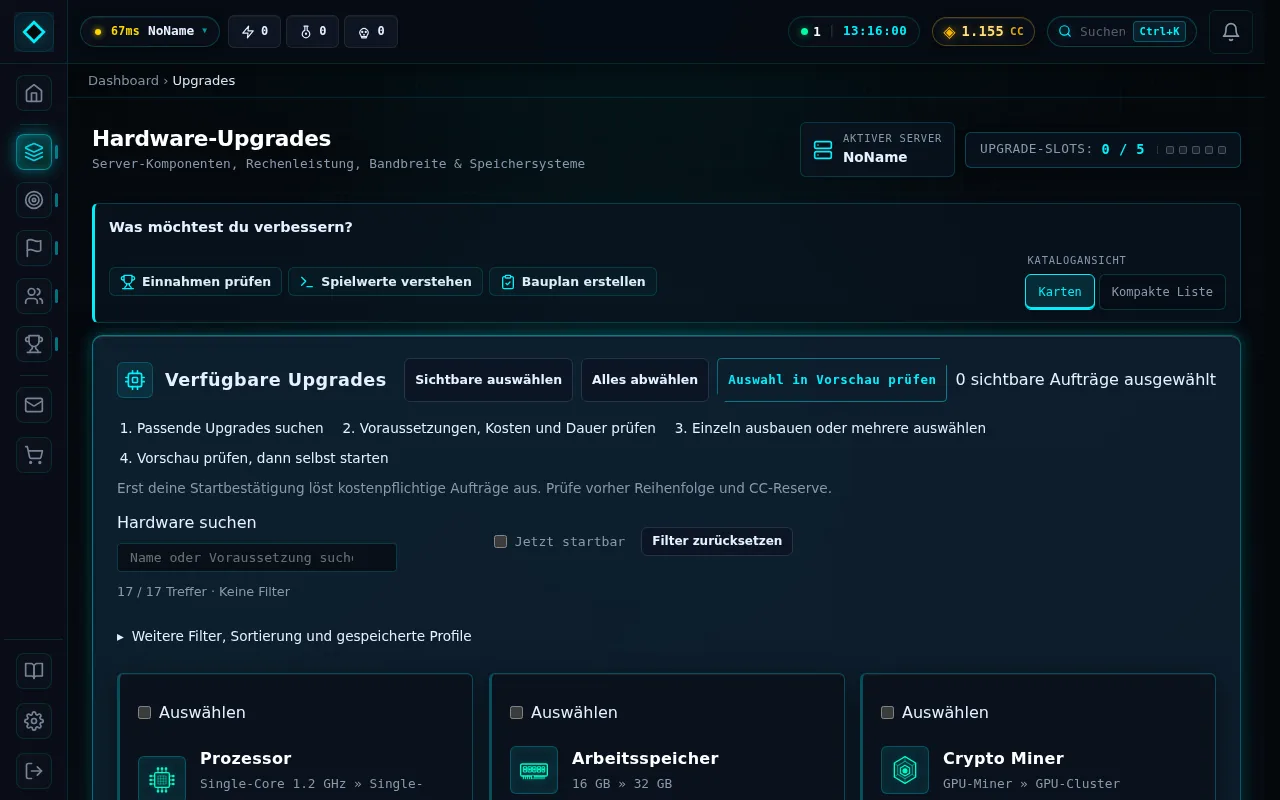
| Module | Max. | Requirements | Effect |
|---|---|---|---|
| Processor | 21 | – | Central Processing Unit. Shortens the duration of research and hardware upgrades (except CPU, RAM and Fiber Link themselves) as well as attack operations. Counts in Netwars and Distributed Attacks for attack and defense and is required for additional attack and research slots. |
| RAM | 9 | – | High-performance RAM. Enables the execution of complex algorithms and speeds up the installation of new hardware components. |
| Fiber Link | 10 | – | Fiber backbone (hardware). Slightly shortens attack operations, contributes a little to attacks in Distributed Attacks and is required for additional attack and research slots. The shorter cooldown between direct attacks comes only from the research of the same name. |
| Hardware Firewall | 10 | Processor 6, RAM 2 | Next-gen firewall. Filters incoming and outgoing traffic. Increases the chance of nipping hostile access attempts in the bud. |
| EDR System | 10 | Processor 10, RAM 3 | Advanced Endpoint Protection. Strengthens your server's defense against PvP attacks and helps fend off Distributed Attacks. It has no effect on detecting attackers; that is the job of the Network Sensor. |
| Onion Router | 10 | Processor 8, Core Framework 2 | Onion Router. Strengthens your server's defense against PvP attacks and contributes a little to attacks in Distributed Attacks. It does not change the detection chance of your own attacks. |
| Network Sensor | 10 | Processor 15, Core Framework 3 | Network Sensor. Monitors traffic for suspicious signatures and helps identify the origin of hostile access. |
| Exploit Kit | 10 | Processor 12, Core Framework 3 | Exploit Kit. A framework for building specialized malware. Unlocks new, more effective attack types with every level. |
| Trojan | 5 | Exploit Kit 4, RAM 4 | Advanced Trojan Framework. Enables various special operations such as targeted data theft or sabotage of critical system resources. |
| Zero-Day Exploit | 10 | Processor 18, RAM 7, Core Framework 5, Exploit Kit 10 | Zero-Day Exploit. Uses undisclosed vulnerabilities to gain full control over hostile servers. The ultimate attack weapon. |
| Crypto Miner | 10 | – | Crypto Miner. Generates more passive CryptoCoin income with every level. From level 2, together with a Crypto Vault, you can transfer CryptoCoins. |
| Crypto Vault | 10 | – | Crypto Vault. Every level increases capacity. Transfers from players and collectives to you are only accepted until your balance reaches the total capacity of all your vaults. Passive income is not limited by this. From level 1, together with a Crypto Miner of level 2 or higher, you can make transfers yourself. |
| Core Framework | 5 | Processor 8, RAM 2 | Core framework. Modular development framework for advanced exploit architectures. Basic requirement for complex software operations. |
| Ad Fraud | 5 | Crypto Miner 1 | Ad fraud. Automated generation of click and ad traffic. Generates passive CC income. |
| Crypto Mining | 5 | Crypto Miner 4 | Crypto mining. Resource-optimized mining network for alternative cryptocurrencies. |
| Ransomware | 5 | Crypto Miner 8 | Ransomware network. Coordinated deployment of extortion trojans for high periodic yields. |
| Exchange Drain | 5 | Crypto Miner 10 | Exchange drain. Highly developed exploits for decentralized and centralized crypto exchanges. |
Processor and memory
CPU and RAM shorten the duration of upgrades, research and operations and are a requirement for additional slots. The table shows the upgrade levels.
| Level | Processor | Memory |
|---|---|---|
| 0 | Single-Core 1.2 GHz | 16 MB |
| 1 | Single-Core 1.4 GHz | 32 MB |
| 2 | Single-Core 1.6 GHz | 64 MB |
| 3 | Single-Core 1.8 GHz | 128 MB |
| 4 | Dual-Core 2 × 2.0 GHz | 256 MB |
| 5 | Dual-Core 2 × 2.2 GHz | 512 MB |
| 6 | Dual-Core 2 × 2.4 GHz | 1,024 MB |
| 7 | Dual-Core 2 × 2.6 GHz | 2,048 MB |
| 8 | Dual-Core 2 × 2.8 GHz | 4,096 MB |
| 9 | Dual-Core 2 × 3.0 GHz | 8,192 MB |
| 10 | Quad-Core 4 × 3.2 GHz | – |
| 11 | Quad-Core 4 × 3.4 GHz | – |
| 12 | Quad-Core 4 × 3.6 GHz | – |
| 13 | Quad-Core 4 × 3.8 GHz | – |
| 14 | Quad-Core 4 × 4.0 GHz | – |
| 15 | Quad-Core 4 × 4.2 GHz | – |
| 16 | Quad-Core 4 × 4.4 GHz | – |
| 17 | Quad-Core 4 × 4.6 GHz | – |
| 18 | Quad-Core 4 × 4.8 GHz | – |
| 19 | Quad-Core 4 × 5.0 GHz | – |
| 20 | Quad-Core 4 × 5.2 GHz | – |
| 21 | Quad-Core 4 × 5.4 GHz | – |
Specializations
Each server has a tactical role. It changes income and combat behaviour. Changing the role costs 1,500 CC. The offensive cluster costs 250 CC/h upkeep; without enough balance its bonuses pause.
| Role | Description | Income | Upkeep |
|---|---|---|---|
| Standard node | Balanced system configuration without advantages or disadvantages. | 100% | – |
| Mining rig | +20% CC/h yield, but +15% loot loss on enemy infiltration. | 120% | – |
| Honeypot trap | Fakes loot: attackers steal 0 CC, their IP is fully exposed at once and the counter-trace creates a dossier of their server for you. 75% less CC/h. | 25% | – |
| Proxy/relay node | Attacks from this server leave 25% fewer digital traces, but it generates 50% less CC/h. | 50% | – |
| Offensive cluster | Optimised attack vectors: +10% attack penetration, −10% operation duration, +25% raid damage; 250 CC/h upkeep. Below 250 CC balance the bonuses pause. | 100% | 250 CC/h |